More Than Just a New Tool in the Toolkit: VFX Executives Take Stock of AI’s Impact
With the promise to speed up cumbersome processes, AI technology still demands the skill, taste and experience of trained artists to reach its full potential.
When a big global ad agency holding companies starts making satirical short films about outlandish claims for AI technology, you might think that talking about AI has jumped the shark. Note we said talking – there’s still lots of actual doing, which is another matter. While AI dominates headlines across industries, there’s plenty of real-world use examples to cite. Every tech-heavy endeavor is immersed in the process of understanding and employing AI in a variety of situations. Film and video production and post are right up at the top of this list.
While the live action production community has been talking about the impact of AI for the past two years or longer, the post production and visual effects communities have been less ‘out front’ in terms of their discussions.
So The Howler turned to an all-star panel of VFX experts to inquire about the impact AI is having on one of the most technologically complex portions of the advertising content creation pipeline. From its earliest days of optical compositing to the development of newer and faster tools for sophisticated CG animation and effects, the VFX and finishing sides of the business has always been the unsung heroes, pulling together the creatives’ vision and the director’s contribution into often breathtaking final products that beg the question, ‘How the hell did they do that?’
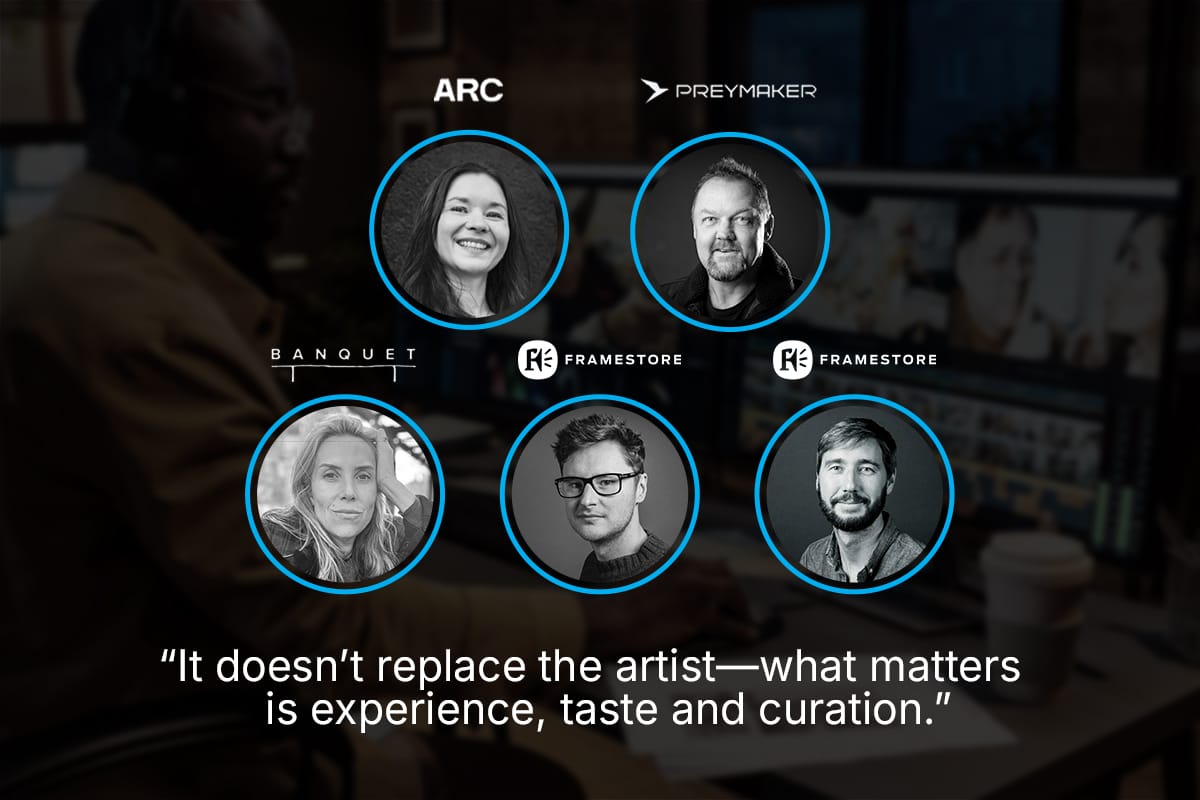
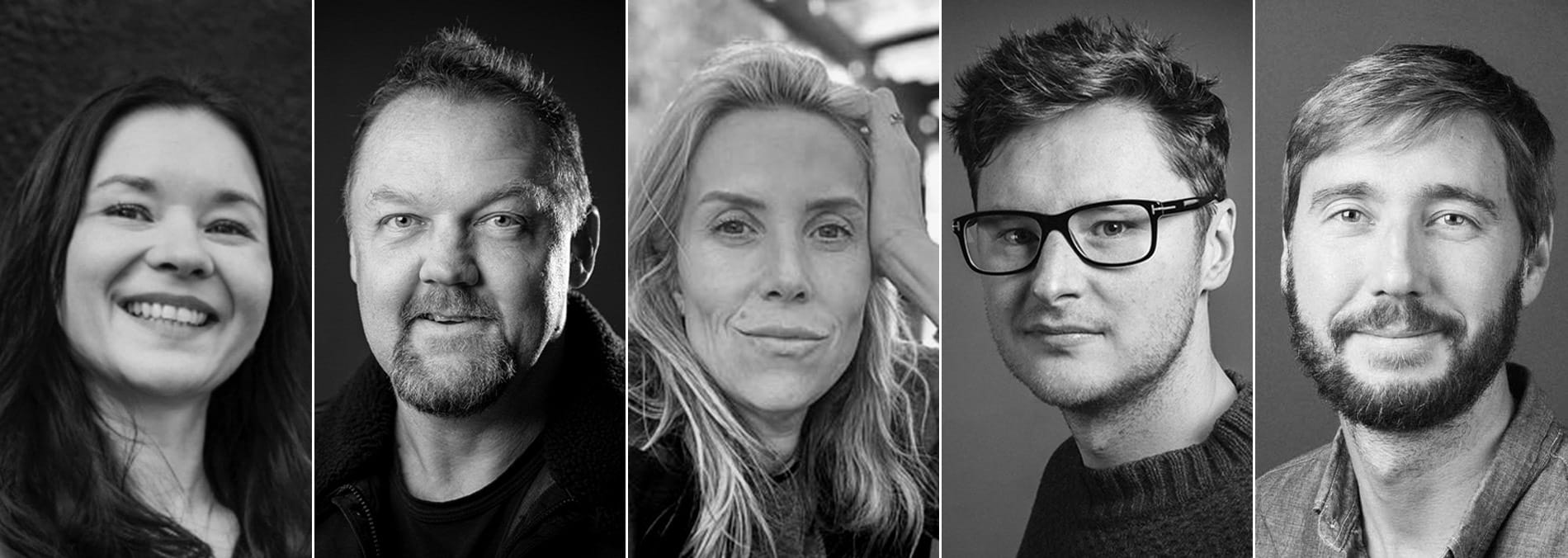
To better gauge the impact of AI, The Howler reached out to executives at Framestore, Preymaker, ARC Creative and Banquet VFX. Here’s a rundown of our survey participants, pictured above clockwise from the upper left:
Angela Lupo, Founder and Managing Director of ARC Creative, boasts a wealth of experience accumulated over two decades in the industry, garnering an impressive understanding of the New York creative scene. As Managing Director of MPC Advertising, she navigated the challenges that arose during its merger with The Mill, and continued with that legacy when she led the 2025 launch of ARC Creative after The Mill closed. As MD, she’s overseen some of the studio’s most high-profile campaigns for clients including Michelob, Meta, Verizon, Tiffany, Calvin Klein and Microsoft, working with such directors as Martin Scorsese, Doug Liman, Tom Hooper, Shawn Levy and Will Gluck.
Angus Kneale, Preymaker’s Chief Creative, is an acknowledged pioneer in the VFX world. His work has garnered recognition from Cannes Lions, D&AD, The One Show, AICP, Adweek, VES and more. An evangelist on the power of creativity, technology and culture, appearing on stage at AICP, The One Show, Digital Hollywood, Siggraph, Advertising Week in New York, NAB, FITC and more. Among its many credits, Preymaker is a leader in leveraging the latest in AI to accelerate and elevate creative ideas, positioning itself at the intersection of live action, visual effects and machine learning. Prior to launch in 2020, Kneale co-founded The Mill NY, where he held the position of Chief Creative Officer.
Camila De Biaggi is Executive Producer and Partner of BANQUET VFX. Before co-founding BANQUET VFX in June of 2025, she was a Senior Executive Producer at The Mill NY, guiding large-scale collaborations and managing some of the industry’s most complex and recognizable campaigns. Since joining MPC/The Mill in 2013 as Head of Production, she’s led teams and client partnerships for such marketers as Microsoft, Meta, Coca-Cola, Mercedes-Benz, Nike, Apple, PepsiCo, Samsung, Verizon, and Audi, working closely with a roster of top ad agencies. Across her 18 years in the industry, she’s earned a reputation for clear vision, calm leadership, and a commitment to excellence in every frame.
Framestore’s Charles Howell, President, Global Advertising & Content, has over two decades experience in working on VFX-heavy projects, including the Oscar-winning film “Gravity,” helping to bring the much-loved Paddington Bear to the big screen, and partnering with Emmanuel Lubezki on the visually mesmerizing Absolut global campaign, 'One Night.' Most recently, his team has delivered cutting edge work for blue chip brands including Geico, Microsoft, and Expedia, as well as TV shows including Marvel’s “WandaVision,” Netflix’s “The Crown,” HBO’s “I Know This Much Is True” and Amazon Studios’ “The Marvelous Mrs. Maisel.”
Theo Jones is Framestore’s Creative Director, AI, a role in which he oversees the studio’s mission to unlock new storytelling possibilities through the integration of Machine Learning and Generative AI. In this position, he spearheads the exploration and introduction of new AI tools across the studio, including the recent global rollout of Futon, a proprietary platform that harnesses open-source innovation within a secure, artist-led pipeline. He’s played a key role with some of the studio’s most groundbreaking initiatives, with credits including “Guardians of the Galaxy Vol. 2,” “Paddington 2” and Disney’s “Christopher Robin,” for which he earned a VFX Oscar nomination. His technical expertise has driven innovative projects such as the award-winning “Field Trip to Mars,” the “Battle for Avengers Tower” VR experience and the LED overhaul of Morgan Stanley’s New York headquarters.
We queried them on a wide range of issues, and if any common thread came out of their comments, it was that AI, like everything else VFX artists have employed over the years, will be simply a tool handled by trained and highly skilled artists. That said, it’s got greater potential than almost anything that’s come before it, and poses a myriad mix of challenges and opportunities to artists, creatives, producers and company owners. Let’s get into the discussion.
How is your studio integrating AI technologies into your workflow? Where and how are you using it most often? Is this something that’s more about pre-viz rather than actually ending up in the final deliverable, or are you creating ‘broadcast ‘ready’ work using AI?
Angus Kneale: We’re integrating AI into nearly every part of our process. We’re mostly using it for look development, as well as using it extensively for concepting, like a sketch pad for creative ideas. We use it to accelerate our process. It’s always used as a component that’s integrated and blended into our traditional workflow.
Angela Lupo: We integrate AI into our workflow wherever it delivers a clear creative or production benefit. Like any new technology, the key question isn't simply can we use it, but should we use it. We often have clients asking us to incorporate AI into a project, but the conversation quickly shifts to understanding whether it enhances the creative process and helps achieve a better result. It’s similar to the approach we took a few years ago with virtual production and The Volume. If the technology serves the project and supports the creative vision, we'll use it. If it doesn't, we won't force it into the workflow.
Today, we use AI and integrate it across multiple areas of our pipeline, from early concept development and pre-vis through to production tasks such as roto, tracking, and image upscaling. It also supports our CG teams in areas including lighting, animation, crowd generation, and environment creation.
We view AI as another tool in the VFX toolkit rather than a replacement for traditional artistry. While it's possible to create complete content using AI alone, our primary use of the technology is to generate assets and elements that are then refined and integrated into our broader VFX pipeline. This hybrid approach allows us to maintain the creative collaboration, flexibility, and level of control required to respond to client feedback and deliver broadcast-ready work that meets the highest standards.
Theo Jones: At Framestore we make a distinction between Generative AI and what we term Directed AI. We’ve used machine learning or Directed AI for many years to optimize specific tasks within the content creation pipeline. These are tools for tasks such as block roto, image denoising or rig deformation, where Framestore maintains full creative control, complete transparency of data provenance and training architecture, and exclusive deployment within secure Framestore infrastructure. We now have Directed AI tools deployed throughout our global VFX pipeline, driving efficiency and helping our artists deliver high-end visual content for directors, brands and studios.
When it comes to Generative AI models, which have been trained outside of the company, Framestore has recently developed a new platform we’ve named ‘Futon.’ This platform integrates these cutting edge Generative AI models directly into the visual effects pipeline, but in a way that can be configured for each client's specific requirements.
Harnessing Generative AI in ways that equip artists with the granular control necessary to respond to client feedback has been central to the development of Futon. So too is rigorous data security, comprehensive model provenance and strict usage controls.
Camila: We’ve been exploring AI since the very beginning of Banquet. One of the advantages of being a new studio is that we were able to build these tools into our workflow from day one, rather than trying to retrofit them into an existing pipeline. We started by using AI for some of the more practical and time-consuming parts of the VFX process, but today it’s being used across the entire creative journey: from concept development and look exploration through to final delivery.
We’re definitely creating broadcast-ready work using AI. For us, it’s not just a pre-viz tool. The most exciting part is finding ways to combine traditional VFX techniques, live action photography, design, and AI to create images and ideas that would have been much harder, slower, or more expensive to achieve in the past.
How are your people keeping up with the latest advancements on what AI can do? What role does it have in helping VFX artists create backgrounds, environments, elements like smoke or water, etc.?
Charles: Framestore has a very structured approach that ensures capture, evaluation, testing, cleansing and deployment of machine learning and AI techniques across the entire organization - putting them in the hands of our artists. This process starts with our Global Insights Exchange group; this is our forward-looking, market-scanning group - essentially a daily conversation with hundreds of visual effects specialists from different backgrounds - and from all over the world. They’re dedicated to monitoring industry developments, evaluating emerging technologies, and testing new services. This ensures we stay ahead of relevant advancements that can be beneficial to our clients. Insights captured at this group get passed up to our task forces for further exploration.
Speaking of which, we have a number of task forces looking into very specific areas and uses for AI. Each group is responsible for defining use cases within Framestore for the technology they're focusing on, evaluating a full range of tooling options for these use cases and working with our Machine Learning Department to get the selected tools established safely within Framestore.
Framestore's VFX breakdown reveals what went into the Walmart holiday "WhoKnewVille" spot for Publicis Groupe.
We’ve had a dedicated Machine Learning Department at Framestore for many years. The team isn’t just about doing research - it’s about being connected to the rest of the company, to drive efficiencies and bring new techniques to everyone, integrating them into the pipeline and altering workflows where necessary. Drawing on insights from the Task Forces and advancements published in academic research, they refine and adapt cutting-edge technology, to ensure it’s usable in production.
Further, our AI Advisory Board serves as the cornerstone of our commitment to responsible innovation in this area. Meeting monthly, this group evaluates every AI model we consider for integration, scrutinizing licensing agreements and the datasets they’re trained on to ensure compliance with our core principles. This rigorous process, involving the most senior executives at the company, guarantees that we not only operate responsibly and legally, but also uphold the highest standards of artistic integrity for our clients. Where our standards are not met, we retrain models, ensuring our processes have full transparency and stand up to legal scrutiny.
Camila: The pace of change is honestly incredible. What felt groundbreaking six months ago can feel commonplace today. Fortunately, VFX artists tend to be naturally curious people. Experimenting with new techniques and technologies has always been part of the culture, so there’s genuine excitement around exploring what’s possible. AI is becoming another creative tool in the toolkit. It can help generate ideas, build environments, create visual elements, and accelerate certain workflows. But it doesn’t replace the artist. What still matters is experience, taste, curation, and the ability to turn those possibilities into something compelling and believable.
Angus: Keeping up to date is a full time job in itself, there’s always something new. We’ve always been technology forward at Preymaker, so it’s part of the culture to embrace new tech. AI is great at some things and not at other things, so we tend to try a wide range of models to choose a direction early on. It’s being used to create elements and components that then get composited together into a final image.
Angela: Our team is actively embracing the latest technological advancements and finding innovative ways to incorporate AI into our daily workflows. By staying up to date and testing new tools, we are seeing how AI functions as a powerful acceleration tool for element creation.
For example, our DMP artists can now feed preliminary concepts into AI to generate multiple versions in minutes, a process that previously took days. They can then take these early concepts and refine them to produce the final result. Similarly, in CG environments, AI is an excellent tool for procedural systems. Instead of manually populating a stadium with people, artists can use prompts to achieve this in minutes before bringing the results into our traditional pipeline for finalization.
By pairing AI tools with skilled VFX artists who have decades of experience, we are bridging the gap between new and traditional methods. This ensures creative integrity in every image rather than producing something that feels solely computer-generated.
There’s been a lot of talk about how AI will impact production, but not so much about its role in creating visual effects and in post production. Is that where you think AI will have its greatest impact?
Angus: I think AI is having a fundamental impact on the entire creative process, from ideation to concept, to production and all the way through the finishing and VFX process. It’s a very powerful tool, and in the right hands can be used to craft great work. It can also be used in the wrong hands to create AI slop very quickly. I think the next few years will see the low/no budget projects turn into a tidal wave of forgettable slop. The high end understands the benefit of craft and taste, and is trying hard to keep as far away from this as possible.
Camila: I’m not sure I fully agree with that distinction. AI didn’t suddenly arrive in creative production – machine learning tools have been embedded in VFX workflows for years.
What’s changed is accessibility. The latest generation of tools has put capabilities that once required highly technical specialists into the hands of a much broader creative audience. That’s incredibly exciting, but accessibility doesn’t guarantee quality.
I don’t know that there will be one area where AI has its greatest impact. What’s becoming clear is that it’s starting to blur the boundaries between production, VFX, and Post production. Creative teams can now explore ideas earlier, iterate faster, and collaborate in entirely new ways. But what will always stand out is creative judgment, taste, and the expertise required to curate and refine the work.

Angela: I believe AI's greatest impact will be across the creative and CG driven aspects of the VFX pipeline. As Camila noted, it's important to recognize that AI, or what we previously referred to as machine learning, has been part of visual effects workflows for many years. What has changed in the last few years is the emergence of more user friendly platforms that have made these technologies far more accessible to the general public.
With that increased accessibility, we’re seeing AI influence VFX and post-production at an unprecedented pace. AI tools are quickly becoming standard for traditionally time consuming tasks such as rotoscoping, tracking, and cleanup. Beyond these production efficiencies, we’re also seeing rapid development across creative workflows, particularly in CG content creation.
For example, artists can now use generative AI to rapidly develop concept environments, matte paintings, set extensions, and background elements. Rather than spending days creating multiple visual concepts, artists can generate dozens of options in a matter of hours and then refine the strongest ideas using traditional VFX tools and techniques.
The key word here is artist. While AI has dramatically accelerated many parts of the process, it has not replaced the need for skilled creative talent. High end visual effects still require classically trained artists to provide creative direction, maintain visual consistency, and ensure the artistic integrity of the final work. AI is proving to be a powerful tool for increasing efficiency and expanding creative possibilities, but the quality of the final result continues to depend on the expertise and judgment of the artists behind it.
ARC Creative scores a gooooaaaallll for Erich & Kallman and Gulf States Toyota in this fast-paced spot.
Charles: One of the fundamental challenges around Generative AI is control. In professional content creation, control matters enormously - but not uniformly. Certain moments demand absolute precision: key performances, narrative beats, character acting, brand-critical imagery, and emotionally significant storytelling moments.
Other aspects of production, such as establishing shots, transitions, environmental details, cutaways, or reactions, often require a different balance, where speed, exploration, and creative variation may be more valuable than frame-perfect control. Part of the opportunity lies in understanding where control is essential, and where it isn’t.
Traditionally, content is created in distinct phases. There’s that well-known saying that a film is made three times: first in the writing, then in the shooting, and finally in the edit. As noted, Generative AI is beginning to blur those boundaries, collapsing stages of the process and introducing new ways of creating, iterating, and refining content.
To fully realize the potential of AI, we need to think beyond simply using it to replicate existing workflows more efficiently. The greater opportunity lies in reimagining the creative process itself - to understand both the strengths and limitations of today's models, understand how the technology is evolving and ultimately where it’s heading - and to design new production methodologies that make the best use of those capabilities. The promise of AI will only be fulfilled if we allow ourselves to think differently about how we work together.
When it comes to creating images of people or animals, where does AI sit versus more traditional CGI? Do you expect to see more Tilly Norwoods? What are the limitations, for now at least, on AI’s ability to work at an acceptable level?
Theo: Character consistency for high end media is still a challenge, however for certain projects and certain use cases, the capabilities are starting to offer new options. A creature that only appears in one or two shots for example, where consistency and continuity are not the paramount concern, may be a great candidate for these emerging workflows. However, the creatives need to be informed about the advantages of these workflows in terms of cost and speed, but also about the very real limitations in terms of control and fidelity.
For us it’s always been about picking the right tool for the right task. Just as we’ve always broken down shots in terms of which ones need CG versus a 2D approach, or which projects might lend themselves to extensive previs or virtual production, we’re now identifying which shots, effects or characters might lend themselves to an AI approach or which might be accelerated via a CG + AI hybrid.
Camila: I’m not sure Tilly Norwood is necessarily the example I find most interesting. People are incredibly sensitive to human emotion and performance, and that remains one of the biggest challenges for AI-generated characters. We instinctively know when something feels authentic and when something feels slightly off.
Animal and creature work is advancing incredibly quickly, and I think that area may experience some of the most significant disruption over the next few years. But whether you’re using AI or traditional CGI, the goal is still the same: creating something that audiences connect with emotionally. That’s the part that’s hardest to automate.
Angela: When it comes to creating people or animals, AI is certainly capable of generating highly realistic results today. In fact, some of our agency partners have publicly stated that they intend to create all of their animal content using AI, and move away from traditional CG creature workflows altogether.
The biggest difference between AI and traditional CGI is control: With a fully AI-generated solution, you're often relying on prompts and accepting the results the model produces. While the quality can be impressive, you lose many of the creative controls that clients and artists have come to expect from a traditional CG pipeline. In CGI, every aspect of a character or creature - from its design and anatomy to its performance, animation, lighting, and final look - is precisely art directed and refined.
At this stage, many of our clients are not yet comfortable relying entirely on prompt-generated characters or creatures for hero shots where performance, consistency, and brand requirements are critical. They still value the predictability and creative control that comes with traditional CGI.
Where AI is proving extremely valuable is as part of the broader VFX pipeline. For example, it can help accelerate look development, assist with lighting and rendering workflows, generate concepts, or populate large environments such as stadiums and crowds where individual performances are less likely to be scrutinized. In these scenarios, AI can significantly improve efficiency while still allowing artists and compositors to refine and finalize the imagery before delivery.
Looking ahead, I do think we'll see more AI-generated personalities and virtual influencers emerge, similar to Tilly Norwood and other digital-first talent. At the same time, with the proper permissions and rights management in place, we'll likely see AI used to extend, recreate, or even bring back beloved performers in ways that weren't previously possible. We've already seen examples of this technology being used to preserve and enhance performances, such as the work done with Val Kilmer in “Top Gun: Maverick” and the upcoming film “As Deep as the Grave,” which suggests that we're only beginning to explore what is possible when AI.
Angus: Using AI for background is widely how we use it. Getting emotional character driven performance from AI just is not there yet. When you want full control, it’s hard to get exactly what you want with A.I. We find ourselves always coming back to live action or hand animation for our high end work.
How do you budget for delivering AI work? How do you deal with it during the bidding process? What client expectations are there for what AI work should cost?
Charles: There’s a lot of energy around faster/cheaper, without the understanding of the level of investment required to get there. There’s also the element of ‘if you’re only interested in faster/cheaper we can do that, and a lot of the time it has nothing to do with AI.’
Angus: We treat it as a tool in our tool chest much like we use 3D, Compositing, Color etc., and it’s becoming a line item that is getting bigger on every project.
Angela: When it comes to budgeting and bidding AI-driven work, we're still approaching it very similarly to traditional VFX projects. At the end of the day, the technology still requires skilled artists to guide the process, evaluate results, and refine the output into something that is both usable and creatively successful.
While AI can often get you surprisingly close to a desired result, it's rarely a one-click solution. In most cases, significant artist involvement is still required to direct the technology, iterate on prompts, integrate the results into the broader VFX pipeline, and perform the finishing work. Our bids are still largely built around artist time and the resources required to deliver a high quality final product.
One of the biggest challenges during the bidding process is managing expectations around cost. Like any emerging technology, AI is often perceived as an automatic cost saving measure, or a way to execute creative work more cheaply. I understand where that expectation comes from; we're all operating in an environment where budgets are tightening and everyone is looking for efficiencies. However, AI is not a magic wand. It's a powerful new tool, but it's still just one tool within the broader VFX toolkit. In some situations, AI can absolutely reduce timelines, accelerate creative exploration, or lower costs for specific tasks. In other cases, the amount of oversight, refinement, and downstream work required can significantly reduce those perceived savings.
Our approach is to have open and transparent conversations with clients from the outset. We spend a considerable amount of time educating agencies and brands on the realistic capabilities and limitations of the technology, helping them understand where AI can provide genuine value and where more traditional VFX approaches may still be the better solution. By involving us early in the process, we can collaboratively determine the most effective workflow for the project's creative goals, budget, and schedule.
Theo: This is a place where Framestore’s breadth of expertise is key. The fact that we serve clients across film, TV, commercials and immersive experiences means we have an enormous knowledge base from which to pull. Our advertising division has had greater freedom to operate in the AI space for the past couple of years, and that’s been invaluable in building up a dataset that can now inform our film and episodic bidding teams. Equally, the scale of our film and episodic divisions means we can bring the scale and rigor of a platform like Futon and make that available to our advertising teams to help them drive efficiency.
Zulu Alpha Kilo booked a reservation with Banquet VFX for this evocative Booking.com campaign, directed by Fiona McGee from Arts & Sciences.
Camila: We don’t approach it all that differently from a traditional VFX project. Clients often assume AI automatically means lower budgets, but in reality the process still involves creative development, experimentation, review cycles, compositing, finishing, and all the collaboration that goes into making great work. The tools may be changing, but the value is still in the creative thinking, problem-solving, and execution. Ultimately, we’re still pricing for talent, judgment, and the ability to deliver the right result.
How do you see the next generation of VFX artists and producers embracing the use of AI technology? How will it impact their training and maturation?
Angela: I think it's an incredibly exciting time for the next generation of VFX artists and producers. At ARC, we spend a great deal of time investing in emerging talent. We've hosted students from SVA and Brooklyn College in our studio, and we've built a very successful internship program in our New York office. Through these programs, we have a front row seat to how young creatives are already embracing AI as part of their creative process.
What's most interesting is that many of these artists don't view AI as a replacement for traditional skills, they view it as just another creative tool. They're using it to explore ideas more quickly, experiment with different visual approaches, and generate concepts that might have previously been beyond their capabilities. We encourage that mindset. AI can be a powerful catalyst for creativity, allowing artists to spend more time exploring ideas and less time getting bogged down by technical limitations.
That said, I still believe the fundamentals remain critical. Understanding design, composition, animation, lighting, storytelling, and visual problem solving will continue to separate great artists from average ones. AI can accelerate execution, but creative judgment and artistic taste remains a human skill. The artists who thrive will be those who combine strong traditional foundations with a deep understanding of how to leverage AI effectively.
For producers, the impact may be even more transformative. Coming from a production background myself, I'm incredibly excited about the potential for AI to eliminate many of the repetitive administrative tasks that consume valuable time throughout a project. Whether you're working in long-form content, advertising, or episodic production, there are countless opportunities to use AI to streamline workflows and improve efficiency.
Shot management is a great example. We've already begun developing tools that can automate processes that previously required hours of manual work. Something as simple as exporting hundreds of shots to the correct specifications, applying proper naming conventions, organizing deliverables and preparing assets for downstream departments can now be accomplished in seconds rather than hours. That may not sound particularly exciting to someone outside the industry, but after spending two decades managing these processes manually, it's a significant leap forward.
Looking ahead, I think AI will fundamentally change how the next generation is trained and how they mature professionally. Artists and producers will spend less time on repetitive execution and more time on creative direction, decision-making, problem-solving, and collaboration. The future won't be about choosing between traditional skills and AI, it will be about understanding how to combine both to achieve better creative outcomes faster than ever before.
Angus: Using AI is a superpower to any talented artist. It’s already an important part of the process and should be embraced by anyone who wants to stay nimble and pragmatic.
Camila: I think the next generation will grow up seeing AI as a natural part of the creative toolkit. What’s exciting is that it encourages a broader understanding of the creative process. Artists are increasingly moving between disciplines and developing skills across design, animation, photography, editing, VFX, and AI workflows.
The most successful artists won’t necessarily be the most technical - they’ll be the most adaptable. Technology will continue to evolve, but creative thinking, collaboration, and storytelling will always be valuable.
If you were asked to sum up in just a few words what you think AI will do to the VFX industry in the next year or two, what would you say?
Angus: I think it is already revolutionizing the VFX industry. People are going to look back and say, ‘Remember how difficult that thing was?’ But keep in mind, it’s not just VFX that's going through a revolution, it’s every industry that uses technology - architecture, law, healthcare, finance, medicine, you name it. Society is going through one of the biggest shifts since the invention of electricity, it’s just happening faster that anyone could have predicted.
Preymaker tapped AI technology to help visualize the characters, then refine, composite and iterate those sketches for this award-winning Toyota spot, produced for Saatchi & Saatchi.
Angela: AI will make VFX faster, more efficient, and more creatively accessible, but artists will remain essential for creative excellence.
Camila: I think that AI will make the industry more accessible, more collaborative, and more experimental. AI won’t replace VFX artists – it will redefine what makes them valuable.
The technology will continue to evolve quickly, but what will always matter is creativity, taste, and the ability to tell stories that connect with people. Those things don’t change. The tools just give us new ways to get there. The studios and artists who embrace that shift will be the ones shaping the future of the industry.
Charles: There’s a significant gap between the current capabilities of Generative AI and what's required to deliver commercially viable creative outcomes - AI can make impressive looking images incredibly quickly and it can mimic the surface of reality. However, professional content creation demands far more than just image generation alone.
We’re working with the leading models daily - we’re closing that gap - delivering iteration, collaboration, performance nuance, continuity and creative control. As these technologies mature, they will accelerate parts of the production pipeline, but also unlock creative opportunities and forms of content that were previously impractical, prohibitively expensive, or simply impossible to produce.