



Every year, Super Bowl Monday is greeted not just with a day-after assessment of the game’s winning football team, but an accompanying (and often higher profile) ranking of who won the beauty contest of Super Bowl commercials. Indeed, with the shift towards advertisers releasing their Big Game spots before the game takes place, spots are being ranked before the big weekend even arrives.
All this coincides with the launch of a new technology product that comes from a company with long roots in the advertising space. Presaige is a cutting edge platform designed to predict the performance of visual content, whether it’s in the form of video or still images. Launched at CES this past January, it was developed by the Northern Lights Family, the parent company of editorial and post shop Northern Lights, the production company Bodega, the audio post and music and sound studio SuperExploder and the design shop Mr Wonderful.
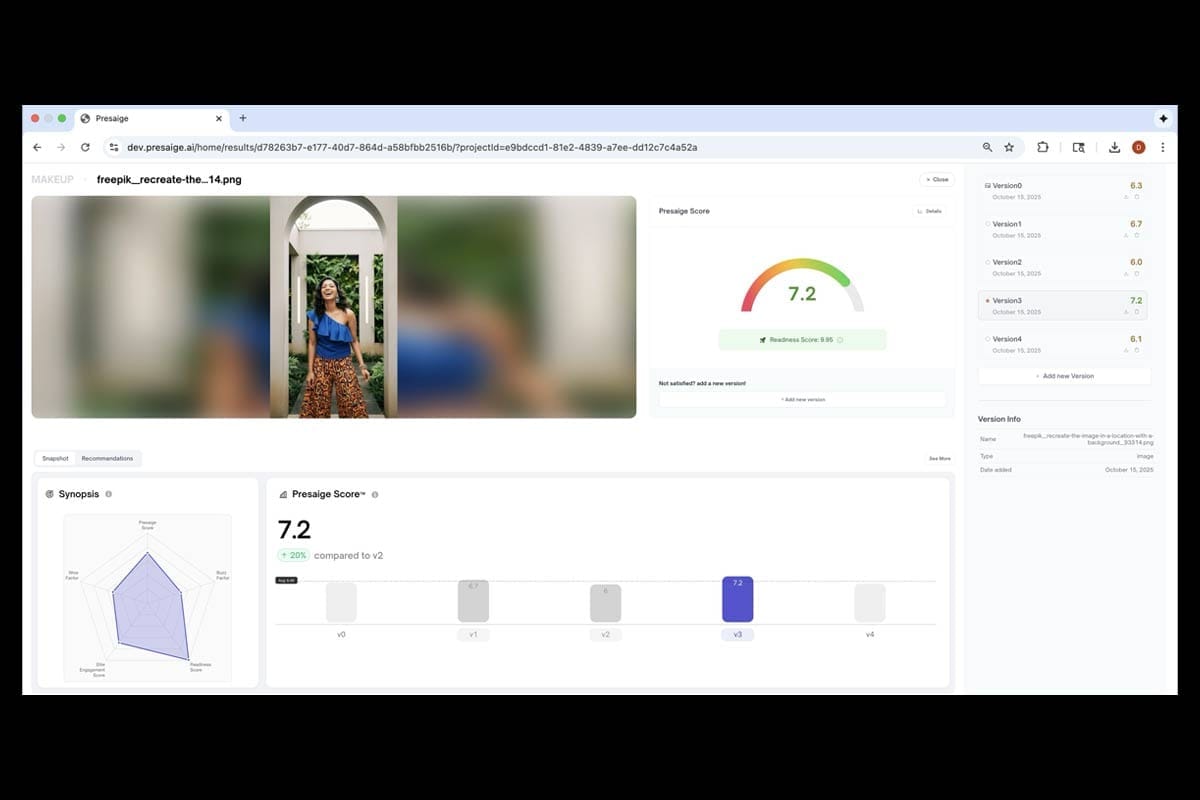
Presaige is an AI-powered platform that predicts how images and videos will perform before they go live. It gives creators, producers, marketers and influences the ability to evaluate work on more than just instinct or focus groups, and is designed to help clients reduce risk, save time and make more effective creative decisions.
This year, for the first time, Presaige is going to run all the 2026 Super Bowl spots through its process and will share the accompanying scores exclusively with The Howler.
Presaige, says its founders, is designed to support human creativity, not replace it, giving content creators better information so they can make stronger and more efficient decisions with greater confidence. Powered by a patent-pending machine learning engine, it analyzes thousands of technical and underlying patterns within an image or video. These patterns, which are impossible for a human to detect, are correlated with real-world engagement outcomes to deliver, within seconds, clear, actionable recommendations. The platform can also indicate when content is optimized and ready to deploy.
Mark Littman, CEO and Co-Founder of Presaige, says the system is ready to take on advertising’s ultimate competitive arena. “We’re really interested and excited to see what Presaige thinks of the Super Bowl spots,” says Mark. Littman cofounded the company with David Gioiella, his partner at the Northern Lights Family. “It’s exactly the stage on which to take big creative bets, and is a perfect example of why we believe our tool is just ‘one in the toolbox,’ and not the final vote. If there was ever a time to try something that ‘shouldn’t’ work, it’s on this forum. So we’re curious to see what our tool thinks. And we are just as excited to see the raw human creativity that will be on display!”
The Howler reached out to Mark to go into the launch of Presaige in more detail. Here’s our conversation:
What motivated Northern Lights to develop this tool in the first place? What was the impetus behind building Presaige?
Mark: It grew out of a frustration we’ve felt for years in production and post. As the Northern Lights Family, we’ve spent over 30 years working with networks, brands, and agencies to create every type of content imaginable. Creative decisions are often made on instinct, and performance feedback shows up after the work is already live, when it’s too late to do anything about it. We were interested to see if there was a way to create an objective, data-driven tool that might help guide creative decisions by accurately predicting how a creative asset might perform.
We’ve seen great otherwise creative underperform simply because of small structural or visual issues that limited its impact. Presaige was built to surface those issues while there’s still time to fix them, without replacing human judgment or creative intent. And to democratize the kind of insight usually reserved for the most highly funded campaigns.
How long did it take to develop Presaige? What was the process like?
Mark: It took roughly two years from initial idea to public launch. We knew from the start that we’d need to build our model custom, from scratch, and not rely on any of the publicly available models. We partnered with a USC faculty member, Mohammad Reza Rajati, who immediately saw the potential of our idea, to lead an R&D team. It took a few tries before we found an approach that showed positive correlation between image data and engagement and effectively proved our theory. Our solution was so novel that we ended up filing a patent for the technology.
One of the biggest challenges was finding the measurable signals hidden within creative assets like images and videos. Editors, directors, marketers and influencers all subjectively know what “feels right,” but designing a machine to synthesize “effective” into bias-free, objective evaluation requires close collaboration between creative and data science and machine learning teams.
What have you used to train the AI component of Presaige?
Mark: Presaige is trained on a mix of large-scale datasets of almost 10 million images and videos that cross applications and platforms. Presaige is a custom, scratch-built model. Some predictive tools use AI-powered “bots” to mimic human focus groups. We think these just systemize the inherent problems with focus groups – that opinions don’t always correlate with actions. Other tools analyze media to detect objects or other recognizable traits and make judgements based on the desirability of those objects.
Our approach is novel in that it searches for patterns hidden within the content – patterns that a human would most likely never be able to detect or understand. We correlate those signals (we found over 2,000) with engagement metrics to result in a truly objective, bias-free, data-driven understanding of how content will perform.
Who do you see as the main users of Presaige? Brands? Content creators? Producers? Agencies?
Mark: Presaige can be used across the entire content ecosystem. Brands use it to assess campaign assets before launch. Agencies and production companies use it as a creative A/B comparison tool, or as an alternative to inaccurate and often biased human or bot-driven focus groups or neural testing. Individual creators use it to improve social posts and thumbnails and drive stronger engagement.

Do you think creative people -- be they copywriters, art directors, directors, editors, writers, producers, etc. -- will be accepting of the recommendations Presaige offers as part of its Readiness scores?
Mark: First, it is important to note that while Presaige’s predictions and insights are very accurate, it was designed to be one (data-driven and objective) voice in the room of subjective creative decisions. Like I said, it’s one tool in the toolbox. It’s designed to help empower creative teams, influencers and marketers to better understand what works, and to ultimately make better and better performing content.
When people understand where the tool is coming from, they are more open to hearing our insights. It’s not there to sideline you, it is there to empower you. Presaige doesn’t say, “This is bad.” It says, “This element may be limiting performance, and here’s why.” It gives creatives something to react to, not a set of rigid rules to follow. In that sense, it functions more like an assistant than a replacement for human creativity. The real shift is recognizing that performance is now part of the craft. Presaige just makes that visible and actionable.
This technology can have a major impact on how clients review and approve commissioned work. What role do you see Presaige playing in this process?
Mark: It can create a shared reference point between creatives and clients. Instead of approvals being based purely on subjective tastes, teams can discuss both creative intent and predicted effectiveness, using the Presaige Score and Readiness Score as anchors for those conversations.
We see it as a tool for alignment rather than control. It helps explain why one version may perform better than another and gives clients confidence that decisions are being made thoughtfully, incorporating data. It can also reduce late-stage revisions by identifying issues before they become expensive problems.
There are already real-world use cases where clients reference Presaige scores to streamline review and approval. For example, an ECD might set a benchmark score that an asset needs to meet before it’s sent up for review. That way, less time would be wasted in revisions. It would also give marketers added confidence that the media they buy will be populated with content that is most likely to yield results.

Presaige made its debut at CES. What was the response once you had a chance to demo it for content creators and producers?
Mark: The response was overwhelmingly positive and very practical. People immediately started uploading their own images and videos and asking, ‘Can I try this on my content?’ That was the most encouraging signal.
Many were visibly surprised seeing the results in real time, especially when comparing Presaige scores and recommendations against content that was already live and noticing strong correlations. Or expecting a long delay before returning insights and scores, as experienced with other testing platforms. Creators immediately saw the value of getting performance-oriented feedback without waiting days or weeks for results. Producers saw it as a way to streamline the creative process.
We emphasize that Presaige works best over time. We’re seeing the most lift in results over 30 days or more of use, leading teams to improve their baseline engagement. We’re not claiming it’s right one hundred percent of the time, but we are saying that using Presaige consistently improves results over time.