



There’s no avoiding it. The Super Bowl is one of those things that touches almost everyone, like death and taxes. The chatter, at least as it relates to Super Bowl commercials, starts months in advance, long before we have any inkling of who’s playing. The game itself, for that matter, is beside the point – the Super Bowl may be the last bastion of true appointment television that’s left to us. Cherish it, we do.
And every year, the Super Bowl ads are picked apart more than the defenses or play calling we see on the field.
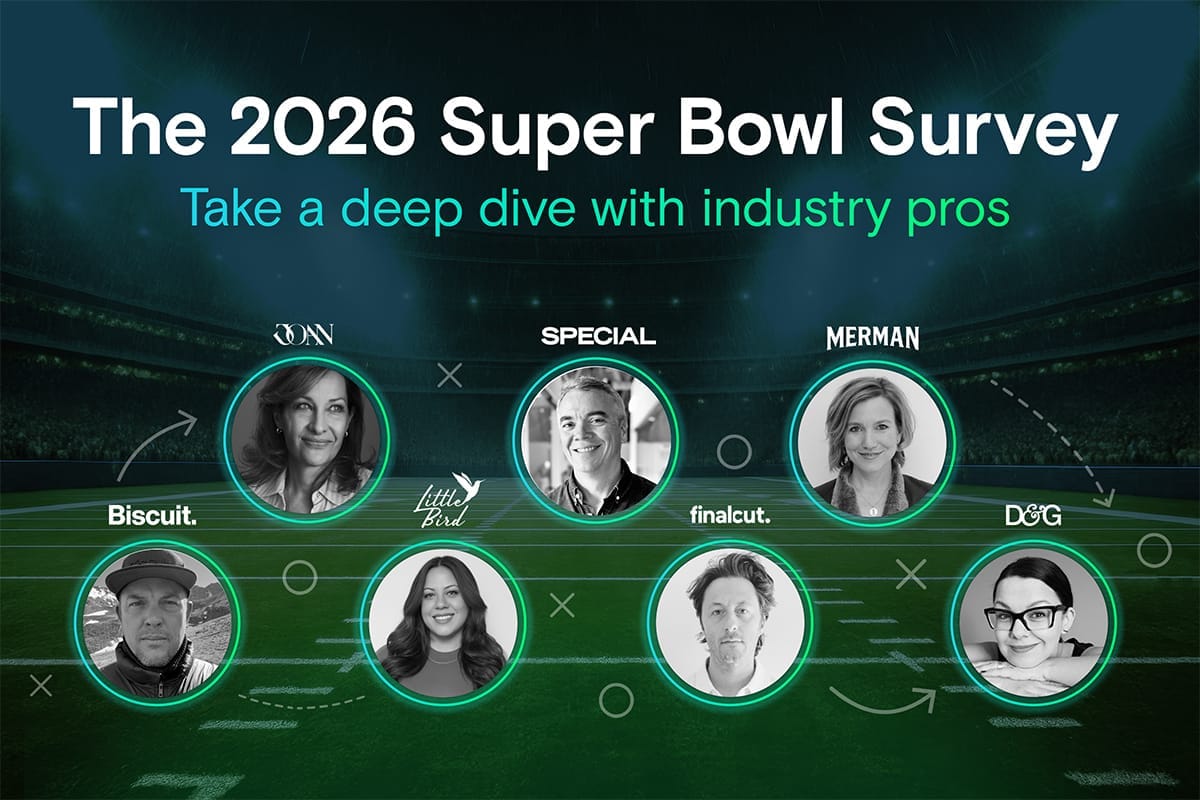
What continues to make Super Bowl advertising so super? How is the category responding to the onrush of AI, the shift to social platforms (typically vertical), and the growth of in-house production and post? The Howler reached out to a septet of industry bigwigs to see what they had to say about these topics, and more. Our 2026 Super Bowl Survey reached out to the following:
Cheri Anderson is Chief Production Officer at JOAN Creative, where she leads the agency’s production department and its JOAN Studios in-house operation. She began her career as a producer, and her path has spanned the agency, production and post production worlds at many of the industry’s leading creative shops and studios.
Patrick Burke is the L.A.-based Executive Creative Director at Special U.S. With the launch of the 2026 Uber Eats Super Bowl campaign, he’s now created 18 Super Bowl commercials for ten different brands at four different agencies, including three USA Today AdMeter winners and eight scoring in the top five. He's been nominated for the commercial Emmy three times, and has won numerous Cannes Lions, including a Grand Prix.
Kira Carstensen is the Global Managing Partner of Merman, where she oversees film, television, and branded entertainment across the U.S. and internationally. She leads Merman’s branded-storytelling practice, producing the Clio Award-winning “Add to Heart,” Walmart’s shoppable holiday series, and MasterCard’s collaboration with Lady Gaga for “Abracadabra,” which won a Gold Lion at Cannes, among many other branded and entertainment projects.
Matt Carter of Final Cut is a multi-award winning editor with a strong grasp of pacing, rhythm and tone and a process marked by attentiveness, observation and intentionality. He’s edited work for such brands as adidas, Facebook, Jack Daniels, Johnnie Walker, Marc Jacobs, Michelob Ultra, Nike, Square, The Whitney, Walmart, and many others, collaborating with such agencies as Anomaly, Johannes Leonardo, Majority, Mojo Supermarket, Translation, Widen+Kennedy and more.
Becca Falborn is the CEO & Founder of Little Bird, a creative representation company that connects agencies and brands with partners from production through post production. Prior to launching Little Bird, she was the EP of Business Development for Lime Studios, with years of experience producing award-winning audio mix and sound design. At the peak of her producing career, she worked on over 25 Super Bowl campaigns over the course of two years.
Avital “Avi” Pinchevsky is Executive Creative Director at David&Goliath (D&G), where she leads creative for Kia Motors, one of the automotive industry’s most ambitious and culturally ascendant brands. Prior to joining D&G, Pinchevsky served as Global ECD at FCB Chicago, overseeing creative work for Cox Communications, Kimberly Clark, and Walmart, among many others. Previously, she held prominent creative roles at Leo Burnett, Crispin, DDB South Africa, BBDO, and more.
Andrew Travelstead has been an executive producer at Biscuit Filmworks in Los Angeles since 2020. Prior to that, he was a line producer for over 15 years for top production companies, handling complex, high-end commercial shoots. He’s produced campaigns for many brands, including Adidas, American Express, Apple, Audi, BMW, Budweiser, Cadillac, Capital One, Coca-Cola, ESPN, Ford, Gatorade, Google, Jordan, KFC, Nike, NFL, Samsung, VISA, and Volvo.
Here’s our Super Bowl convo:
Almost every year, there seems to be at least one Super Bowl ad that stirs controversy. Especially with the surge in generative AI usage, are you expecting to see a spot this year that causes a brouhaha?
Patrick: I assume we’ll see some of that. I think some brands are now actively trying to be controversial, chasing that reaction. But it’s a difficult thing to do well. Today's consumers are savvy enough to spot when we’re trying too hard. It’s like saying, “we need this to go viral.” That’s not how it works.
It’s one thing to act fearlessly and not shy away from controversy, but it needs to be a great, original concept that’s right for your brand. Otherwise you stand out in the wrong way. Like the creepy uncle who shows up at the keg party.
Kira: If you’re going to spend millions on the Super Bowl, it should create a brouhaha. Otherwise, what’s the point? As long as the spot conveys who you are as a brand, then take the big swing. There are always going to be people who love it or hate it. In this day and age, anything can cause a ‘controversy,’ whether real or manufactured. But if it’s who you are, stand by it and ride the wave.
Avi: Yes, I’m almost certain there will be. Our industry has a penchant for stirring up a little drama, and the Super Bowl puts every creative choice under a cultural microscope. Add generative AI to the mix, and people are even quicker to call out what feels off. Whether intentional or not, a brouhaha is pretty much part of the tradition.
Becca: Totally! It wouldn’t be the Super Bowl without a campaign pushing people’s comfortability levels, and with this year's broadcast already seemingly being one of the most controversial with Bad Bunny’s halftime performance, we already know the big campaigns are prepped to push boundaries. Even just the teaser for the Skittles campaign that’s taking their non-traditional route with a more direct-consumer-driven approach is stirring up buzz!
Andrew: There better be! I think the goal of any Super Bowl commercial is to cause a stir. A discussion. An immediate awareness. I’ve been so disappointed with the level of craft seen over the last few Super Bowls. SB spots should be dangerous. What’s the point of airing an unmemorable commercial with that large of a media buy!?!?!?!? Let’s GO!
Matt: I wouldn’t be surprised. As Avi said, the Super Bowl puts every creative decision under a microscope, so even a small risk can turn into a big conversation. Whether it’s generative AI or a bold creative swing that hits or completely whiffs, there’s almost always one or two spots that set social media on fire the next morning. AI could definitely add fuel to the conversation.
Cheri: Oh, I’m sure there’ll be one or two. Although in some ways, I think the AI excitement card has been played. Then again, you never know what will get the chat rooms talking. I hope the brouhaha will be about an innovative form of communication or a brand taking a big swing, not who is using AI.
Speaking of AI, ads tapping this tech are being met with a range of reactions, from outrage to yawns. Do you think it’s risky for brands to run spots on such a highly visible stage that utilize AI-generated imagery?
Matt: Yeah it’s risky, because AI is a cultural trigger. Existential questions around authenticity, ethics and the future naturally come up whenever we see it. That said, because most people understand that AI will continue to evolve and grow, I doubt it’s avoided altogether. It’s really up to us to use it responsibly, if possible. Ideally, AI could exist without sidelining human talent, creativity or the emotional intelligence that actually brings us together. How brands strike that balance this year will be very telling.
I think it’s also important to remember what’s at the heart of this issue. It’s not the technology itself that’s inherently risky, but it’s what happens to humanity when efficiency and profit become the priority – which is nothing new. It’s more about how we use it at this point.
Avi: I don’t think it’s risky if the idea is strong enough. Like it or not, AI is here to stay. When brands use it in a smart, innovative way, especially if they bring the audience in on the joke, it can feel entertaining rather than polarizing. The risk isn’t the technology itself, it’s using AI as a shortcut instead of a tool. At its best, AI should help serve a bigger idea, offer something fresh, and make the work more engaging. It can’t replace the thinking, heart, and soul behind it.
Cheri: The goal with a Super Bowl ad is to get your brand talked about, not the technology you used to make the spot. While I see the backlash in conversations, I’m not so sure any brand is going down because they try something new. AI is here, it's not leaving, and right now is the bumpy time of experimentation. Mistakes will be made. Breakthroughs will happen. At some point, we’ll find a decent equilibrium. I hope that equilibrium manifests as a place where AI’s use is that of a tool and an accelerant, not a place where it’s used for replacement, misdirection or deception.
Kira: Agreed, AI is a tool, like any other in filmmaking. Sometimes it’ll be appropriate for an idea, and sometimes not. The important thing is to use AI and not let it use you. Creating things in AI for the sake of using AI is meaningless, and audiences will know it. But if you’re using AI to enhance an idea, say to extend a creator’s vision, then that’s a good use of technology. The best use of AI is invisible. You shouldn’t be able to tell it's there. When it’s obviously AI, I think it is harder for audiences to emotionally connect to the spot, and thus to the brand.
Patrick: I’m not an AI denier. It’s clearly reshaping our industry, and it’s already a useful tool in the creative process. But at this stage, it too often seems like it’s the novelty of it that gets attention, like those cardboard 3D glasses in the 80’s. “Jaws 3D” was a terrible movie. The novelty of the 3D glasses was why I begged my parents to stand in line on opening weekend. (The difference, of course, is that 3D goggles stayed a novelty. AI clearly won’t.)
As for the risk, I think it depends on the brand. If a brand does lean into AI for the Super Bowl, they’ve likely done the calculation and feel the risk is worth it.
Andrew: I think running a one-hundred percent AI-generated spot is boring. It lacks humanity. It lacks connection. Honestly, they have no soul. People will tune out.
Becca: I’m probably the most anti-AI person, which is more due to the fact that I don’t want it to be taking jobs from amazingly talented and creative people. I do think we’ve seen, through past controversial ads like the Coca-Cola holiday ad last year, that it’s a risk for sure, but arguably it did its job by stirring up buzz and getting people talking about it. That said, regardless of my personal opinion on AI, it’s definitely an impressive tool that can hopefully be integrated as part of production, and not as a replacement for people who can make more personal-feeling and nuanced work.
Given the tremendous pressures associated with the Super Bowl, do you foresee a time when younger, up-and-coming production and post talents will get a chance to tackle these assignments? Or will they remain the province of more grizzled veterans?
Andrew: Grizzled? I hope not! Talented veterans? Why wouldn’t you want that level of stewardship as a client? Handing over the keys to a SB campaign should be about craft and skill. BUT - that doesn’t necessarily mean young or old. Talent will always rise to the top, and talented directors and post houses will always be given the opportunity to shine. Just don’t mess it up…
Kira: There are brands like Doritos that famously give opportunities to young talent to grab a spot in the big game. And many times, a smaller spot or PSA done by an up-and-coming director gains traction and makes its way to the Super Bowl. But these are still the exception, not the norm.
Cheri: I don’t think the Super Bowl is about grizzled veterans at all! Talent and craft comes in many shapes and sizes. There is incredible younger talent out there, and those of us who are choosing partners in the creation of a Super Bowl masterpiece should be open to fresh points of view.
Becca: I think it’s already happening, but definitely not enough – considering the youngest director who’s worked on a SB campaign was Remy Neymarc, who directed the Dannon Oikos Super Bowl spot at age 21 for the 2012 broadcast – a game I vividly remember, as it was also the last time my New York Giants won a Super Bowl and the second time they beat Tom Brady’s Patriots. I have noticed, however, an uptick in agencies asking us reps for new talent, asking for Gen-Z influence, and just in general being more open-minded to working with new talent. I think we’re at a tipping point, and I’m excited to see it happening in real time.

Avi: With an audience that massive and a media spend that high, you do need to lean on seasoned professionals. The financial and reputational risk is simply too big not to. But that doesn’t mean Super Bowl spots should be closed off to emerging talent. It’s actually the perfect moment to bring young up-and-comers into the fold to share their fresh perspectives and new ways of thinking, while giving them the chance to learn from veterans who’ve been there before. The real magic happens when experience and new energy work cohesively to create something incredible.
Patrick: I honestly believe we will see more of that, but it may happen slowly. With this level of investment it’s tough to roll the dice, to walk into a pre-bid meeting with our clients and say, “I know we don’t see it on this person’s reel, but we’re pretty sure they’ll nail it.”
Then again, we’re also seeing teenagers with iPhones outcompete big-budget productions for attention, and brands are noticing. Today’s consumers pay closer attention to how brands show up, and who they partner with. Again, it depends on the brand, but the fear of being seen as out-of-touch is real.
Matt: Some of the most innovative work comes from people who haven’t spent decades in the industry, but bring fresh perspectives and approaches. Sticking only to familiar circles carries its own risk.
Can you see a day when in-house departments, whether at agencies or holding companies, can routinely handle high-leverage assignments like the Super Bowl? Or will they largely be handled by trusted independent production and post vendors?
Avi: It’s possible. It really comes down to where the talent goes. High-profile work like Super Bowl spots have always followed skilled professionals with trusted reputations, not a specific model or structure. Agencies still focus on ideas, with creativity being the main product we sell, and that remains deeply attractive to exceptional talent. If in-house teams continue to attract top talent, there’s no reason they couldn’t handle assignments of that scale. Ultimately, brilliance travels, and the best work will follow the people who know how to deliver it.
Patrick: For post work I think they’re already in the mix. Plenty of great talent has gone in-house, bringing in years of experience. And even more are available freelance. That said, when Super Bowl productions inevitably go haywire, it’s nice to have a great, experienced production or post company beside you to keep things on track.
Becca: I don’t want to ruffle too many feathers here, but I do think the most sought out talent for these kinds of campaigns will remain largely at independent companies, not in-house production and post facilities. And I hope that remains the case, because if it goes the other way then all of us independents will be a thing of the past. That just seems like a terrible doom for the industry as a whole.
Matt: It’s possible, but it would definitely come with a price.
Kira: The issue always boils down to talent. If in-house departments can garner the level of talent that independent production and post houses have, then of course they can effectively execute a Super Bowl ad. But there’s something in the independent spirit of producers and directors at production companies, and not big corporations, that enables a creative team to think and to see the world differently. It’s the combination of the client, agency and production team that makes magic. When it’s a singular company making the project soup to nuts, it can create a myopic, tunnel vision. It’s the combination of different voices and visions coming together as a team that makes film, TV and advertising so unique.
Cheri: I can’t speak to the ability of any specific holding companies’ in-house departments to take on a Super Bowl ad, but I don’t see why not. If the idea is great, everyone has access to incredible resources. What I can say is that there’s a plethora of incredible talent all around us. Those independent production and post companies invest in and grow that talent. They’re specialists in their craft, and we should not and cannot discount that. As an industry we should be working together to support and invest in one another. That collaboration will result in memorable, enduring storytelling for our clients.
Andrew: It feels like the advertising landscape is rapidly moving in that direction. But it’s coming at the expense of creativity. In-house agencies don’t have the (external) agency to push their clients, their “stakeholders." But that’s what good advertising needs. We need to challenge a brand’s comfort zone. Brands will never cause “brouhaha” (The Howler’s expression) when making formulaic, comfortable work.
How well do Super Bowl spots work in other media formats? They often tap high production values and lush, cinematic looks. Can they effectively be repurposed for IG Stories, TikTok placements of Facebook Reels?
Pat: Possibly the worst part of this process comes in the final days, when we’re forced to sit in a dark room for hours, re-framing/re-sizing our meticulously-shot Super Bowl commercial for social framing. Obviously, if the idea is great it still translates. But when we do it right, we’ve planned ahead for it, and it’s often the other assets that do better on those platforms, such as social-first extensions of the Super Bowl campaign.
Kira: I always like it when a brand creates a universe of content around their main Super Bowl spot, when the social assets are extensions of the idea but not direct lifts. I love it when a brand uses the native language of social platforms to tease out an upcoming spot or narrative storyline, or to show an audience other angles or a continuation of the story they saw on air. But it should be content created specifically in the native language of the social platform. Just shrinking down a spot made for TV to fit in a 9x16 format is a disservice to the campaign.
Avi: : The best Super Bowl work is built on a big idea, not just high production values, and big ideas travel well across platforms. When the concept is strong, it can be reimagined for IG, TikTok, and Reels in ways that feel native rather than cut-down. A great example is what D&G did with Kia’s “Binky Dad” for Super Bowl LVII. It was a beloved, high-performing Super Bowl spot, and we naturally extended it into a TikTok experience where viewers could watch different endings and vote on their favorite. That kind of platform-specific thinking is what allows cinematic work to live past its 30-second time slot and thrive well after the game is over.
Andrew: I know brands love social media, and you can’t deny that it’s been an extremely successful marketing tool. But, your phone is NOT the best place to experience the game OR a great SB spot. Brands should endeavor to make spots that look great on the big screen. Will they translate to social media mediums? Of course. But I think the goal of an SB social campaign should be to augment the SB spot. It shouldn’t be the hero.
Matt: Yeah they can work and should be considered from day one. It’s hard to tack on a load of spots for different platforms as an afterthought without compromising the work.
Becca: Social media is the new broadcast so, yes, they’re all adapted to shorter versions, lifts, cutdowns, etc., specifically for these platforms. I also think that’s how you actually can get new business directly from an ad - everything we see on IG or TikTok is linked to an easy “buy now” or “subscribe to” format that engages the consumer. An adjusted aspect ratio is merely a small feat for the brand to capitalize on their work.
So what was your most memorable Super Bowl experience, either as someone who had a hand in making a spot that ran on the Big Game, or as a viewer?
Cheri: Long ago I produced a Super Bowl spot for the NFL Network that was about the teams that DIDN’T make it to the Super Bowl. The logistics meant we had to be ready to shoot many scenarios with different teams’ players, but wouldn’t know who they were until the final playoff games, leaving a mere two weeks to shoot, edit and deliver! To add to the craziness, we told all the players to sing “The Sun Will Come Out Tomorrow,” from the Broadway show “Annie.” Nothing like telling a giant athlete who just LOST their bid at the Super Bowl to “go again, you were a little off key on that one.” It was completely bananas and one hundred percent fun. And Jerry Jones let me try on one of his Super Bowl rings.
Patrick: I’ve recently relocated to L.A. to join Special U.S., and our current Uber Eats Super Bowl production will definitely not soon be forgotten (or ever). An amazing team and incredible clients. But my most memorable Super Bowl experience was in 2020. An agency of 14 people, with a creative department of six, somehow snuck its way into two Super Bowl “jump-ball” pitches, and won both. On New Years Day (with a mild hangover) I flew out to shoot our Rocket Mortgage spot with Jason Momoa.

Then, the day I flew home (also with a mild hangover), we had a creative call with Bill Murray and Brian Doyle-Murray, for our Jeep script that had somehow, miraculously found its way to them. That phone call happened exactly three weeks before Super Bowl Sunday. We shot the Jeep “Groundhog Day” spot one week before the Super Bowl. Our stress level was only topped by our elation that all of this was even happening to our tiny agency. Definitely my most memorable Super Bowl experience. (Giving a shout out to our incredible production and post partners back then, O Positive and Cutters/Another Country, and to my previous agency, Highdive.)
Matt: My most memorable Super Bowl experience was going to the game in 2001. Another string of Super Bowl memories comes from my grandfather, who went to all FOUR of the Buffalo Bills’ Super Bowls in a row. Unfortunately, we lost every single one. Go Bills.
Avi: Two come to mind. One was filming Kia’s “Perfect Ten” spot for Super Bowl LVIII, where we worked with a first-time child actor and figure skater. Her parents had intentionally kept the fact that it was a Super Bowl spot from her, so she wouldn’t be too nervous. At the end of the shoot, we shared the exciting news with her, and the shock and pure joy on her face is something I’ll never forget.
Another memorable moment was last year, when D&G didn’t produce a Super Bowl spot at all for the first time in 10 years. Instead, we launched Kia Squares, a creative spin on the traditional Super Bowl Squares game, where people could participate digitally to predict scores each quarter for a chance to win a new Kia. The engagement was off the charts, and we loved owning part of the Super Bowl conversation while, in a way, stealing attention from it.
Andrew: I’ve been fortunate to line produce and EP several great SB spots. But as someone behind the camera, the best part of an SB project is being in the weeds of it all. Everyone is excited about the opportunity to collaborate on something that will be shown on the big stage! It’s a source of pride for our crews. Perhaps even a time to show off to friends, family, and your advertising peers. But come on, Bud’s “Whassup" from 2000? That’s hard to beat. ?
Becca: The Super Bowl hits home for me. When I was a Sr. Audio Post Producer in 2019, I worked on 12 Super Bowl campaigns. It was the most any producer on my team had handled in one season. Now here’s where it gets a little sappy - 2019 was also the year my grandfather passed away. We called him Pop. He worked in advertising during those old-school Madmen days in the 70’s, 80’s and early 90’s. He was in hospice the month leading up to the game and was very close to passing. I went to see him knowing it could be my last time. I was telling him about all the campaigns - mind you, he was basically skin and bones and could barely speak, but still mentally very sharp. He chimed into the conversation, clear as day – “What agencies?” - which made me giggle while holding back tears. I told him the list (BBDO, JWT, Grey, W+K, etc.), and his eyes lit up. “That’s big time!” he said. He was so proud of me. I told him he needed to make it to February 3 to see all my ads, but he sadly passed just before the game. It was a bittersweet moment, but a memorable one. I know he was there in spirit and I know he left me proud as ever.
Kira: Ridley Scott’s “1984” ad for Apple was a huge moment for me. I was very young, but at that moment I realized commercials could be cinematic masterpieces.