



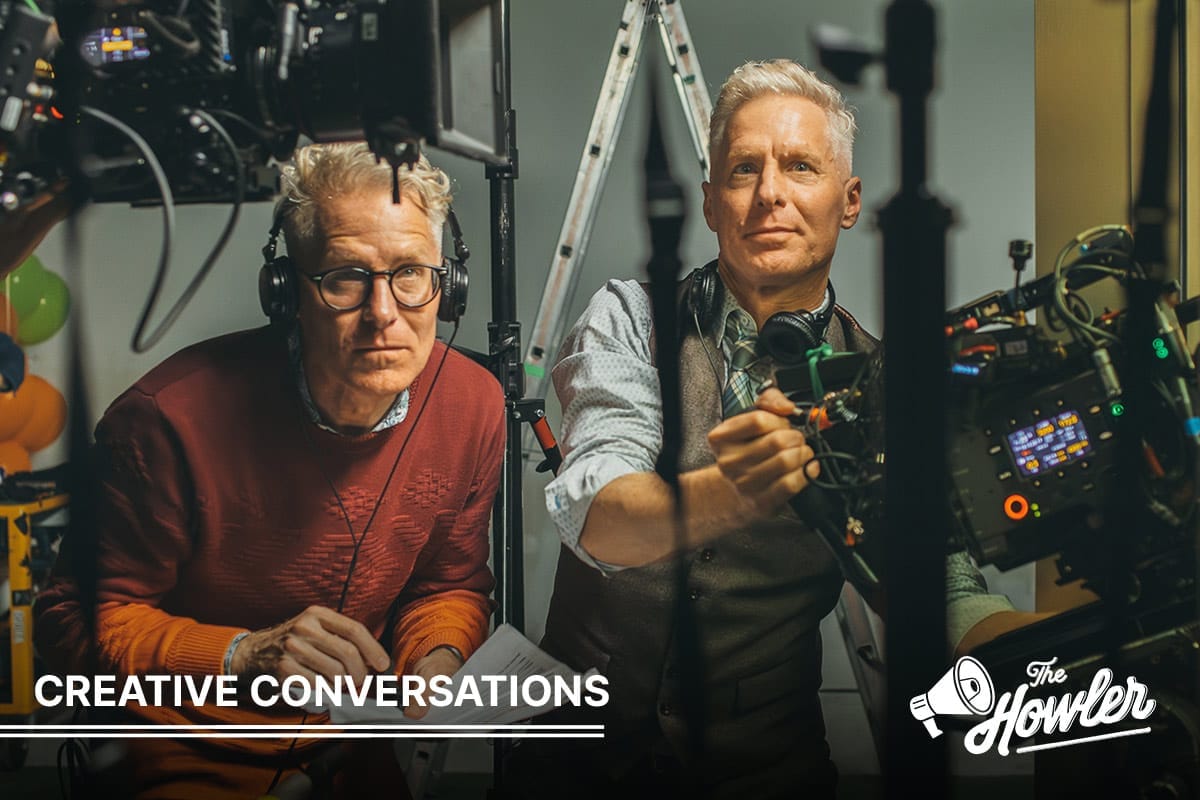
When we came across the comedy work of Jason and Matt Docter, founders of the production company Thinking Machine and identical twin co-directors, we were immediately curious. So how does this work, we wondered. Besides the usual directorial team question of who does what, we were intrigued by how being not just siblings but identical twins factor into their creative partnership. What benefit does it present to clients on the agency and brand side? What are the downsides, if any?
Fortunately, Docter Twins, as they call themselves, are super talkative when it comes to discussing their shared history, their collaborative process and how it shows up in their work. You can see it in their spots for brands like FedEx, Old Spice, eBay, Preparation H, Hefty and others. Recently, they flexed their comedy chops in a series of absurd Liberty Mutual ads that feature Limu Emu and Doug set against the Macy’s Thanksgiving Day Parade. Their comic sensibility – and their penchant for working with actors and creating a free-flowing, ensemble-like vibe – is on display in work for the financial data and analytics tool FactSet. Created by VSA Partners, the spots revolve around a blowhard, know-it-all office worker who spouts irrelevant factoids at his office mates when they’re busy discussing key issues facing their business.
Jason and Matthew launched Thinking Machine back in 2021 and have gone on to shoot Cannes Lions-winning ads since then. The Howler kicked off our latest Creative Conversations column by asking them to toss a few pithy questions to each other about how they do what they do. Here’s what they had to say.
So you've chosen to work in a relationship with your brother. What’s the best part of that? And then, what’s the worst part?
Jason: I think the positives of working with your twin are many: dividing and conquering, using it as a superpower, being able to trust in someone else’s creative vision that you share.
I mean, we tend to push and pull an idea, or for lack of a better word, yin and yang it, and explore it in every way possible to find the best route of the problem. And that can sometimes be exhausting, but I think in the end, we come to a more creative place because of that back and forth. So that's my thought on why it's good. The worst part of working with your brother is that you have to talk to him every day. No, I think the worst part is probably, and I mean this in all sincerity, being an identical twin. In fact, I'm looking at you right now going, ‘God, do I look like that person?’ So you have this constant mirror in front of you.
But I think it’s probably deeper, in that you see similar flaws or weaknesses that you think you don’t have, but then you see them. I try to stay on the positive side, but I think those can kind of be amplified, or maybe they’re more noticeable because you see someone who is, for lack of a better word, your clone, who’s doing it. And I think we tend to do that.
Matthew, what’s your take?
Jason: Yeah, clone, what’s your take on those two points?
Matthew: The worst part is the patience it requires and the number of times you get interrupted, which we can count in this conversation. The best part is a lot of what Jason said – you have someone who brings an idea. And I don’t think this necessarily is so much about being a twin as it would be about working with any partner. But you have someone who’s constantly bringing an idea that you might not have thought of, and that you get to claim as your own because you’re a partner in the project. Often, when we’re both aligned on an idea, it’s great. It’s when one of us likes something and the other likes something else, that’s where it gets a little tricky.
I don’t think we think a lot about it because we are twins, versus if we were just working together as two co-workers, like an art director and a copywriter at an agency. But there’s an aspect of it that becomes a challenge; like, you’re quicker to judge when you don't like something. Whereas with an associate, you’d be like, Oh, sure, go ahead,’ unless they were just ruining your pitch or something you wanted. For the most part you’d be like, ‘Well, that’s not necessarily how I would do it, but that’s cool.’ But in our case, it almost feels like you want to reach out and go, ‘Wait, stop.’
So that’s definitely a challenge for us as twins. And that’s something we’ve had to learn over the years. Early on, when we were first directing, we’d just cut right to it. I’d say to Jason what I thought, and he’d say to me what he thought. And the whole room is sitting there going like, whoa, this is uncomfortable. But it’s not to us; it’s how we talk.

How do agency and client peeps react to your being identical twins? What’s the reaction when they meet you on the pitch calls, when they go to the first pre-pro’s, when they meet you on set?
Jason: Often they don't even know. They’re like, ‘Oh, we didn't realize, we thought it was just a fun name.’ We're like, no, our last name is Docter and we’re identical twins. You asked us earlier about how we came up with this name, and if there were any twins that inspired us. And there were, they’re from New York, the Starn twins. They were fine art photographers who’d gotten into a bunch of installation work, and they shot the cover for R.E.M.’s “Out of Time” album. And we liked how they just called themselves by their last name. And we thought, if we’re gonna do this, let’s be the Docter twins. That’s how we came up with that. I find their work inspiring.
But some people ask if we’re really twins. We’re like, yeah, we’re twins. I wear glasses, because my eyes are chronically dry. Matthew hasn’t had that happen yet. Hopefully his genetics will let him avoid that. But our hair is the same, and when I don’t have glasses on, it’s pretty obvious. Then again, we used to audition for twin roles, when we first got to L.A. Talk about a trippy environment, being in a room with 40 or 50 sets of identical twins dressed exactly alike.
Matthew: It’s an interesting question, because you don't realize how weird you are as a twin until you see other twins. And then you’re like, wow.
I think once they get to know us, they sort of realize that this is our dynamic, it’s how we work. But they’re definitely curious. And I think probably some of the savvier agencies, maybe they’ve worked with directing duos before, they’ll sometimes ask us on calls, ‘How do you guys work?’ Because they see they’re getting into something that isn’t just going to be one singular voice saying, ‘This is how I think this should go.’ And we have a knack and an instinct for dealing with that.
You mentioned dividing and conquering. How do you approach the work, not just on set, but everything leading up to when you start to actually shoot?
Jason: We pitch and concept together. And we direct individually on some projects as well. But for the most part we sell ourselves as a duo, and if we can both be at the shoot, great. If not, if our schedules overlap, you’ll still get two minds driving a creative arc, which comprises all of our creative input in casting and prep and ideally about the shoot as well.
Once we get on set, we’ll establish a lead, as we’re both equally proficient. That said, Matthew comes from a camera background, so typically he’ll block the shots with the actors while I’ll work more on performance. And while we decide who’s doing what in advance, it tends to change in the moment; for example, one of us may go talk to the agency and make sure we’re getting their input while the other is setting up the shot. I think our overarching quality, which hopefully is a selling point, is that the best idea wins.
Matthew: And sometimes I wonder how one director can cover it all. Like, if someone comes up with a wardrobe question, I’ll just point to Jason. I don’t want to think about it, because there are so many other things I’m dealing with. And if either of us have a suggestion or a tweak, we’ll explore that. But this allows us to move fast.
On the recent campaign we shot for Liberty Mutual, we shot three :30s in a day. And they were fairly complex, as we were recreating the Macy’s parade. There were lots of moving parts, and we were able to get through it. I didn’t talk to the wardrobe stylist on this project, since I had so much else to deal with. If I had to, I think something would have probably not have turned out as well, because you just can’t physically handle that much when it’s such a big project.
Your work for the financial software brand FactSet has been a study in how ensemble comedy works in commercials. What are you hoping to achieve with the next iteration of the campaign, based on your work for the brand so far?
Jason: We want to make them funnier and more memorable. In the last spot, we had a cast member sort of spewing off facts, and while that’s funny, there’s not as much interaction between the ensemble. We’re aiming to almost improv it a bit, to bring in more comedic moments and line readings from other cast members interacting, either with dialogue or something physically happening between them. So this time, we’re expanding beyond the key guy played in the last spot by Wyndham Maxwell, the ‘facts’ guy; it’s now going to be the personification of an AI character, which is going to be fun. We’re working with a great pool of talent on this spot, and without moving beyond the script, we’re finding moments that feel, for the lack of a better term, unscripted or organic in the comedy, you know.

Matthew: That’s one thing that’s great about this client and the agency creative team, which is led by ECDs Kim Mickenberg and Megan Schultist, as well as everyone else, they’re on board with us exploring and riffing. They’re always looking to add even more to the scripts.
We’re limited, because you need to keep moving, but as Jason says, sometimes some of the funniest stuff comes when you’re just playing back and forth. If you sort of deconstruct the concept, you can come to the essence of what it’s all about. It’s like working with an editor – when they see the footage, they can restructure it in a way that’s different from what you saw in the storyboards, and it brings a new take to the spot. It’s like finding that lightning in a bottle; you don’t know it until you see it, but you have to have the time, or make the time, to try and find it.