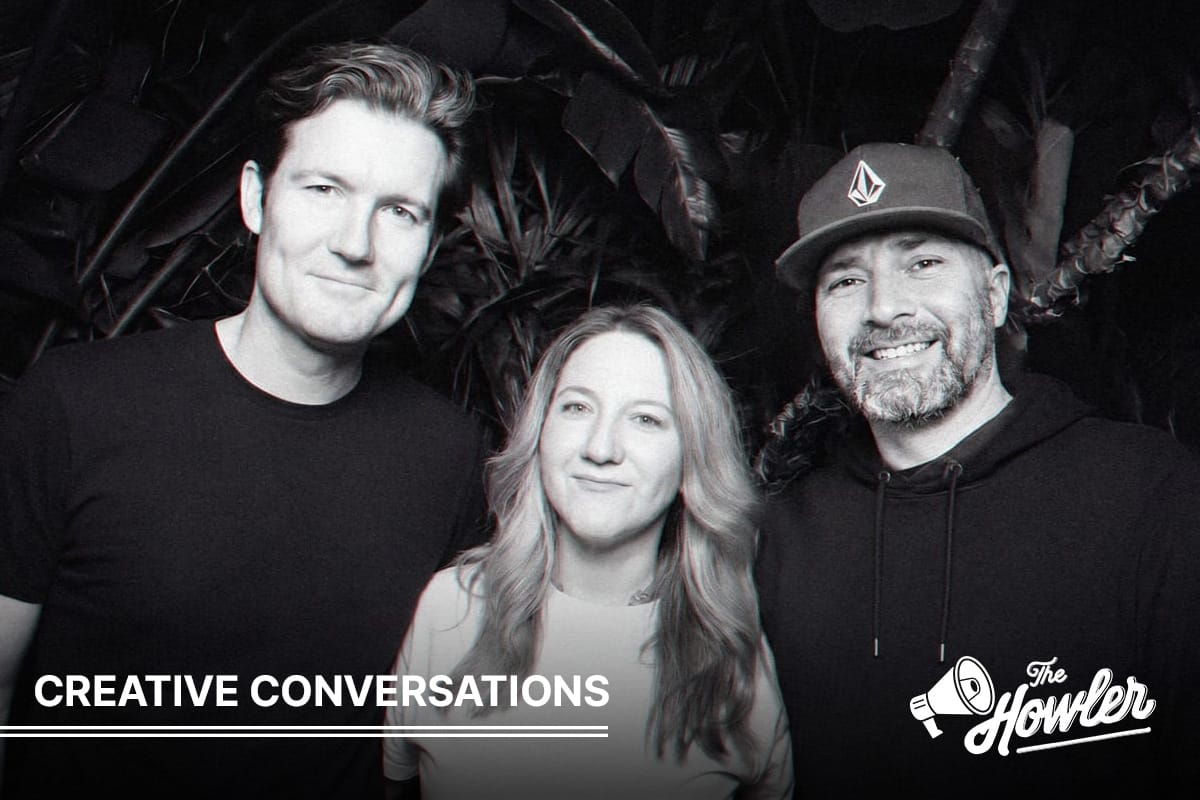
Cutters Editor Tim LoDolce and CDs Katie Bero and Brian Culp on the Art of Landing the Joke
First off, they all agree on a few things: The essence of good comedy is often in the writing, but it comes together in the edit. Action films rule. And Arnold Schwarzenegger is the nicest guy you could ever imagine.
That’s just a few of the takeaways from The Howler’s latest Creative Conversation, this one with Cutters Editor Tim LoDolce and his frequent creative collaborators, Group CDs Katie Bero and Brian Culp, now at Callen. The latter have worked with Tim while they were at Highdive and again while at the Chicago office of TBWA\Chiat\Day (formerly known as DDB). Together this trio has turned the work of many gifted filmmakers into such notable spots as the State Farm Super Bowl blockbuster “Like a Good Neighbaaa,” in which director Jim Jenkins tried to get the Terminator to say ‘neighbor,’ to hilarious effect. They’ve also worked on a recent Skittles campaign that, as Katie puts, was deemed ‘truly bonkers’ by some of its Gen Z target audience – and when it comes to Skittles ads, that’s saying a mouthful.
Katie, a copywriter, and Brian, an art director, first met as students at the Minneapolis campus of the Miami Ad School. Years later, they partnered up at mcgarrybowen in Chicago and have been working as a team ever since. Tim’s work as an editor has earned numerous glitzy industry honors for such brands as Jeep, Nintendo, Lays, Rocket Mortgage and many others, laugh riots one and all.
The Howler sat with the trio to talk about what creatives look for in an editor, how to coax the biggest laughs out of a TV commercial script, and the origins of their comic sensibilities. Here’s how the convo went down.
Katie and Brian, how did you get connected with Tim?
Katie Bero: We’d been working with other editors for a while, and had switched agencies and heard amazing things about Tim. And that was on the first State Farm campaign we did, the one with the “This is Ludacris” and “Nightmare” spots, both of which were directed by Jim Jenkins. We connected with Tim and did that job together and it was just such a great partnership, he just became our go-to editor.
What made you realize that there was a little bit of a comedy simpatico between the three of you?
Brian Culp: We just found that our sensibilities really aligned. Typically, when working with a new editor, you’re feeling things out. We don’t like to be too prescriptive right out of the gate, we like our editors to take a stab, let them time the takes and see what they gravitate towards. And with Tim, it aligned with a lot of what we thought were the best takes.
And just being in the edit with him, seeing how hard he works and how much he’s willing to tinker, because we love playing around and trying things. And I think just that first job was such a great experience and a lot of laughs. And we felt like we had a really good creative partner with us.
Arnold Schwarzenegger's State Farm spot was a Super Bowl standout.
Tim, from your perspective, what clicked with you when you started working with Brian and Katie?
Tim LoDolce: Similar to what Brian said, I think we connected on taste and shared the same comedic sensibilities – we’d just laugh at the same things. And I’d show versions and we’d be like, ‘Meh,’ and then I’d show a different version and we’d laugh and be like, ‘Yeah, that’s the one.’ And we’re constantly trying to find the funniest bit, always working to find the best. And it’s not annoying to keep tinkering like that. I’m not always annoying. Just sometimes.
How closely do you collaborate? And what are the key elements to getting the comedy to work in the edit?
Katie: We work pretty closely together. I think we all know pretty quickly if something isn’t working. I mean, basically, if we’re not laughing, it’s not working.
Even recently, we had a campaign we were working on, and we couldn’t quite figure out what the ending was. And we all just sat there and brainstormed, and we found a resolution. So I just feel like for us, a good thing about us being in Chicago is being in the same room with Tim.
And I think the other great thing about this partnership is that Brian and I have such confidence in Tim now, even if we’re struggling with something, we know we’re going to figure it out again. Back to what Brian said, Tim kind of never stops tinkering. You’ll come in the next day and he’ll be like, ‘I had an idea last night. Let me show you guys,’ and it’s almost always very funny and has just like plussed up the edit.
Tim, when you go to show them a first cut of something, what’s going through your mind?
Tim: I still feel a little nervous showing first edits, but I’m blessed to say I’m excited to show Brian and Katie their work for the first time, because there’s always something good in there.
So Katie and Brian, you’d done that first State Farm campaign with Tim, and the very next one was the Arnold Schwarzenegger “Like a Good Neighbaaa” spot for the Super Bowl. Was there any hesitation giving that to Tim? Any added pressure?
Brian: Yeah, it was just our second job with Tim. I think, again, we had such an incredible first experience. And I know that others at Highdive had cut some of their Super Bowl spots with him, so there was good big stuff on his reel. So we had the confidence. I think we were all feeling, obviously, the pressure, because it was the Super Bowl.
And, you know, Tim’s also a big old school action movie fan. We knew how pumped he was to work on it as well. So we felt strongly that Tim was the guy for the job. And it worked out nicely for us.
Katie: And we’d learned from our first job with Tim that he was going to be honest with us if something didn’t work, because I think with comedy and creatives, you can get really caught up thinking your stuff is funny. And sometimes you need somebody to tell you ‘We’re holding on the joke too long.’ And we felt like we found a really good creative partner in Tim who’d tell us when we were beating a joke to death.
Two dudes find comfort in the pouch of a weird kangaroo-like character in "Soft Pouch," edited by Tim LoDole.
You talked about Tim being an action film junkie. What are your shared comedy references? Where do you all find common ground in terms of what’s funny and what’s not?
Brian: I think we’re all over the place, it depends on the project. Because we all like good comedy writing and just well-crafted and timed jokes. But we also like great physical comedy as well. And especially with the Skittles ads, we like taking things off the rails, keeping people on their toes and messing with what’s expected.
We talked about this lately, we've been watching stuff like “Hacks” and “Shrinking,” stuff with good comedy writing. But Tim and I have talked a lot about things like Tim Robinson humor and cringe comedy, where you just take a joke and keep pushing it to the point of just like exhaustion. So yeah, we’re all over the place.
Tim: I’ve thought a lot about this, too – like, where does somebody’s comic sensibilities come from? And for me, I think I just trace it back to “The Simpsons.” I got a lot of my comic timing from that. When I’m editing, I see things and go, ‘Wow, that’s kind of like a Simpsons joke, the way that got paced out.’ So I can always lean back on that, or Seinfeld. Just old school good comedy timing.
Have you always cut comedy? When you were starting your career, was comedy one of your touchstones?
Tim: It’s weird for me, because I always wanted to be a comedic editor. And I kind of found myself doing a lot of emotional stuff early on; I was always doing these big, anthemic pieces. And so I thought that was where I was headed. But I always wanted to do comedy, and then thankfully I got the opportunity to start doing some in very small doses. And then it just built and built. And now I’m known more for that than anything. But as an editor, I’m all over the map, I kind of do everything. But I love comedy; if I could always work in comedy, I’d be good with that.
Katie and Brian, what do you look for in an editor? Is it more chemistry than craft?
Katie: There’s a couple of things. I don’t think you can completely judge an editor on the script, because they didn’t write it. So a lot of times you’re looking at timing – are they getting out of jokes at the right moment? Are they holding on to things for the right amount of time? Hopefully an editor gets the opportunity to cut something the way they wanted to.
And you can also tell when somebody’s reel is funny. That’s kind of a no brainer. Like you can tell, ‘Oh, they’re drawn to the same kind of work as me.’ And then Brian and I also look at who are the other creatives who are picking them. And if there are creatives who have the same sensibilities as we do, we usually know that’s pretty good. We look at work we like and then see who cut those spots. That’s always a nice way to find editors as well.
You track down the creative people and ask, who are you working with? Who do you recommend?
Katie: The only time we’ve ever talked to creatives we didn't know was actually for a director. But yeah, for editors, it’s usually word of mouth. That’s how we found Tim. We heard from a lot of creatives in Chicago who we respect, and thought were the funniest creatives. All had great things to say about him.
There you go, Tim. I hope you're blushing. And your work with Katie and Brian has a fair amount of VFX. So how do you make sure the effects are working to further the story and deliver on the gags?
Tim: I try to mock up as much of the VFX as I can quickly, because you could easily spend a long time trying to do some of this stuff. I mean, you’ll see all kinds of crazy characters and composites in the spots I’ve done with them. I try to mock them up quickly, because I think that’s a big part of it. If you kind of see the final in the rough cut, it definitely helps us judge the comedy.
And I’ll mock up as many different ideas as I can. There’s a lot of sound design that comes into play too with the VFX, so I’m trying to put as much of that together to see what sounds help push the VFX. Like in our Skittles “Balloon Dog” spot. On the set, you didn’t hear the balloon making any noises as it scooched across the rug, but just adding in the scooching sounds really went a long way in seeing the final. So yeah, we’ll remove arms and heads and put the right takes on the right things.
Brian: I think State Farm’s “This is Ludacris” was made up of like four different body parts and takes.
Katie: Oh my God, yeah.
State Farm's "This Is Ludacris" was Tim LoDolce's first project with Katie Bero and Brian Culp.
Tim, is it your role to make sure that everything lines up and works perfectly in the final cut?
Tim: It’s my role to make sure all the partners are on the same page. I mean, we have had takes and versions before that were very ambitious with some of the VFX. And I don’t need to get into specifics of that, but we have had a cut go away because the VFX didn’t work. Thankfully, we presented it early on to be like, ‘We’d love to do this if we can.’ And it just didn’t work.
The VFX, if it’s not going to work and it looks fake, we don’t want to go that route, even if we think it’s the funniest. So I think early on, as much as we can get a rough cut into our partner’s hands, then I’ll give it right to the Flame artists and finishing artists just to see.
What role, if any, do you see A.I. playing in the work you do together? How will it impact the editing process, the creation of VFX, putting together treatments or storyboards, etc.?
Brian: I think there are positives and negatives. From a positive standpoint, it’s a new tool that could let us try things faster. I’m never quite satisfied with a lot of A.I. stuff, it just feels not quite right or a little artificial. We shot all the Skittles effects practically, and I think if we’d have tried to do that in A.I. or CG, they would have lost some of that magic. I think people can tell, and they appreciate it when it’s real. And actors benefit, too. A.I. can help from a pre-production standpoint, and it lets us focus more on the ideas. But in the end, I think real humans crafting things with real human taste is what people are drawn to.
Katie: To build on what Brian said, I do think it’s kind of an incredible tool to have in pre-pro, and I think it helps us sell some ideas more easily. It can help with the proof of concept, and the level that it gets you to is awesome, so there’s incredible pitch theater.
And it saves time on things that have just been grueling in the past – like it saves Brian hours of time comping, where now he can spend more of that time thinking instead of having to Photoshop a keyframe for a spot. But also, to Brian’s point, I think especially for comedy, there’s an art in knowing how to land a joke that I don’t believe a machine is ever going to be able to figure out.
Tim, how are you guys integrating AI technologies at Cutters?
Tim: We're using it a lot for audio right now, like for scratch voiceovers and roughing out the pacing before we get the real talent to record. We're also using it as a tool to enhance shots that need a little extra help. For instance, adding eggs into a boiling pot of water is something that actually worked really well and looks 100% real! But I’m still trying to learn and get better every day because we’re getting lots of requests to use it. I love having the ability to create anything in the room with the creatives if we need it. Like, if I wish we could have gotten a close up of a character’s hand holding the product – well, now I can quickly generate that using the images we have from the shoot, throw it into a spot and see if it helps us land a joke. I think that's where we're going to use it a lot more. It’s going to help us if we need to fill in the gaps.
What are the keys to finding the funny in an edit room? Is it really coming down to timing and finding those little nuggets in the footage?
Katie: Yeah, and I think part of it too is being willing to kind of reinvent the spot. Brian and I like to make sure when we go on set that we have a lot of not just alt lines, but like alt ways to turn the spot. Like even with that Skittles “Soft Pouch” kangaroo spot, that morning we were like, ‘Oh man, what if this doesn't feel right when we cut it together?’ So we wrote a completely different version of the script and captured that too, where the kangaroo was more like, ‘You guys got to get out of my pouch.’ I think it’s just making sure you have the pieces, then being willing to find a completely different version of the spot in the edit.
More Skittle from from Katie, Brian and Tim, helped along by some cleverly placed sound design.
So you have to make sure you’re giving Tim as many options as possible to build the story?
Katie: Yeah. I think if you give your editor the film as scripted, you’re putting them in a box, because they have nothing to play with. And they’re just going to cut what was on paper, because you didn’t give them anything else.
Brian: You know, that’s true. Not only like finding stuff on the set, but again like just finding stuff in the edit. I can’t remember how many times we were laughing hysterically at a joke on set, and then we get in the edit and it’s like, ‘Oh, it’s not funny anymore.’ When we’re working with Tim, it’s great being able to come back to things the next day and being honest with ourselves. You can tell that sometimes maybe a joke has lost its magic
Tim: And vice versa, too. Brian and Katie are great to work with because they’re very open. And they’re willing to go back and fight for something that maybe was seen as not funny when it was shot, but it can turn out to be completely different when you get into an edit. We all think it’s worth exploring that stuff, just to see what you have. You might have gold and not even know it.